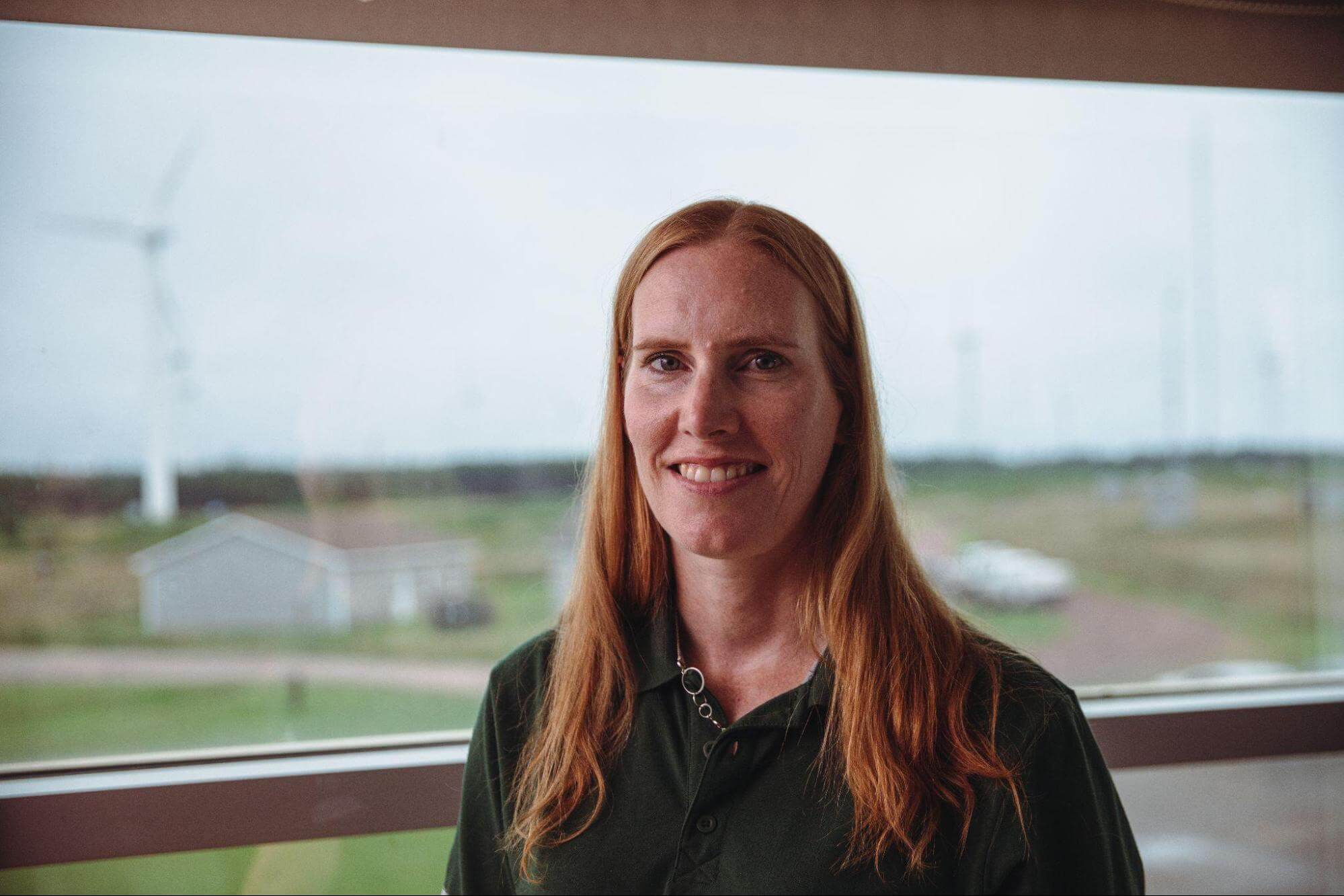
Vivian Beer is the Manager, HR Strategy for the PEI BioAlliance, where she is leading AI readiness strategic support for the sector. She also has her own company, Merdock, where she provides sector-based HR strategy services and manages one-to-one business meetings programs for conferences. Outside of work, Vivian is a vocalist and composer. She has released seven songs, including a concept EP this year, and takes one course each semester at Holland College's School of Performing Arts.
As an introduction: what you do, your connection to PEI, and what you love doing outside of work?
I have my own company, Merdock, where I provide sector-based HR strategy services and manage one-to-one business meetings programs for conferences. I work predominantly as the Manager, HR Strategy for the PEI BioAlliance, where I am also currently leading AI readiness strategic support for the sector.
Outside my work, I am a vocalist and composer. I have released seven songs, including a concept EP this year, and take one course each semester at Holland College's School of Performing Arts.
I grew up in Prince Edward Island and completed my business degree at UPEI before working in Toronto in international marketing and sales. Since returning to PEI, I've had the opportunity to pursue many of my interests, including writing community history, serving as Chair of the PEI Museum and Heritage Foundation, and creating music.
Take us back to before AI Together. How did you feel about AI then: excited, skeptical, a little intimidated? What or who got you to your first session, and what's kept you coming back?
I first attended AI Together during PEI Tech Week. I was already developing the bioscience sector's AI readiness survey and micro-learning series while evolving my AI knowledge. The series was a gift at the right time.
I wasn't too intimidated when I first went to AI Together, as I've spent my career around engineers, music producers, scientists, and for a brief stint, game developers, so I am accustomed to learning from people with deep technical knowledge. AI Together was also a small, friendly group generous about sharing what they knew.
I've encouraged other non-developers to attend. You may feel lost the first time or two, but the effort pays off. What keeps me coming back is the culture of curiosity, experimentation and learning.
Let's start with work: the dashboard you built for HR metrics. What problem were you trying to solve, which tools did you use, and when did it sink in that you'd built a working app yourself?
I gather quarterly HR metrics for the bioscience sector that reside in spreadsheets. After an AI Together presentation about Base44, I set up an account. I chose one use case: searching jobs advertised in the bioscience sector by year, company, job category and job title. I planned the architecture in ChatGPT and built the dashboard in Base44.
I quickly learned the importance of cleaning data. Category headings and subheadings had to be repeated on every row, and company names and job titles had to be consistent. Once the data was clean, I watched the dashboard come to life and later added a one-page PDF print function.
I learned some basic fundamentals:
- Pick a simple use case.
- Take the extra time to clean the data.
- Know the result you want.
- Don't design yourself into a corner; think about expansion.
- Don't underestimate what experienced users know about good functionality.
Now for play: your app that turns ECG heartbeat data into music. Where did the idea come from, and what was it like to hear a heartbeat as music for the first time? Did you try it with your own heartbeat?
I am part of an experimental music group. On a whim, I took my ECG on my Apple Watch, exported it as a PDF, and uploaded it to ChatGPT to translate the pattern into a melody using a set of rules. I took the resulting MIDI file into Logic Pro and added instrumentation, while keeping the melodic sequence unchanged. You can listen to the unreleased composition I Give You My Heart here. The final version will feature instrumentalists.
A co-worker suggested the idea could become an app, so I built a functioning version using ChatGPT Work and presented it at AI Together that week.
One of your apps lives in the world of HR metrics, and the other makes music out of heartbeats. What do your HR side and your musical side have in common? Did building one make you better at the other?
Yes. In both cases I turned data into something of value. Completing one project gave me more confidence to tackle the next, and I was also delighted to bring my bioscience and musical worlds together through biological data and music.
Each project improved my planning, prompting and testing skills. That is part of what makes AI Together valuable. The series brings curious experimenters together with people who understand the rigour of building digital products.
I would love to see even more professions and industries represented. One week, we invited a science professor who uses machine learning to understand and teach genetics and evolution. There were no scientists in the audience, yet we were fully engaged in the possibilities.
Every builder hits a wall, whether it's running out of tokens or an AI that just won't do what you ask. What was your most frustrating moment, and how did you get past it?
The most frustrating moments came when the prompt was not quite right and the app changed in ways I hadn't intended. I learned to spend more time clarifying what I wanted before building. Since then, a best practice that I learned at AI Together is to prompt the LLM to ask key clarifying questions at the outset.
I also noticed when ChatGPT created a change prompt for ChatGPT Work, it often included a laundry list of things not to change. I found humour in watching AI prompt AI.
What are you building or learning right now? How do you find inspiration for the next feature?
My earlier experimentation spawned an idea for my next musical project. I have built four apps that capture data related to voice, seeing, hearing, and heartbeat, which I plan to translate into musical compositions.
What would you tell someone who's curious about AI but worried they're not "technical enough" to build something?
You do not have to be technical to begin building with AI tools. You need curiosity and a willingness to experiment.
At AI Together, we learned how a developer created an AI-enabled app for an autistic child after reading the book AI for Good, written by Josh Tyrangiel.
Instead of thinking only about AI potential, think about human potential.
Where can people find you online? And if you share your music anywhere, where can we listen?
You can find me on LinkedIn, on Instagram @vivianbeermusic and on Spotify or Apple Music. Also, you will find me regularly at AI Together.